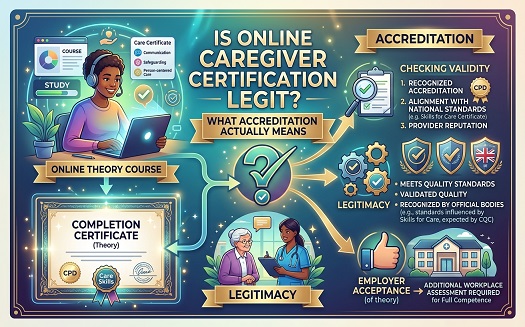
It's a fair question, and one worth taking seriously: if you can complete an entire caregiving qualification from your phone, on your own schedule, without ever setting foot in a classroom, is it actually legitimate? Or is it just a convincing-looking certificate that employers will see through the moment you hand it over?
This scepticism isn't unreasonable. The internet has a long, well-documented history of "diploma mills" — operations that sell certificates for a flat fee with little or no real assessment behind them. It makes sense to want reassurance before investing your time and money in an online caregiving course. The good news is that legitimate online caregiver certification absolutely exists, and it's widely recognised across the care sector — but the difference between a credible qualification and a worthless piece of paper comes down entirely to one word: accreditation.
This guide explains exactly what accreditation means, how to tell a legitimate online caregiver certification course from an illegitimate one, and what to check before you enrol anywhere. By the end, you'll be able to evaluate any caregiving course with confidence — including deciding whether MS Caregivers Academy's certificate and diploma courses are the right fit for you.
Why So Many People Ask This Question
Before addressing accreditation directly, it's worth understanding why scepticism around online certification runs so deep, because the concern isn't irrational:
Diploma mills are a real, documented problem. According to the U.S. Federal Trade Commission's own consumer guidance on diploma mills, companies have been caught selling fake high school diplomas and degrees online, charging a flat fee for a multiple-choice test with no real coursework behind it, and even fabricating fake accrediting bodies to appear legitimate.
The online education market is genuinely crowded. A quick search for "online caregiver certification" returns dozens, if not hundreds, of providers — some rigorous and well-regulated, others little more than a landing page and a PDF certificate generator.
Care work carries real stakes. Unlike a hobby course, caregiving certification is meant to prepare you to support vulnerable people. It's reasonable to want assurance that a course has actually taught and tested the competencies it claims to.
Employers have been burned before too. Hiring managers in the care sector have encountered candidates presenting certificates from providers with no verifiable accreditation, which makes some employers understandably cautious about certificates in general — reinforcing the importance of choosing a provider whose credentials can be independently checked.
Given all of this, asking "is this legit?" isn't cynicism — it's exactly the right question to ask before enrolling anywhere.
What Does "Accreditation" Actually Mean?
This is the term that gets thrown around constantly in course marketing, often without much explanation. Here's what it actually means, stripped of marketing language.
Accreditation is a formal process by which an independent body evaluates a training provider or qualification against a defined set of standards, and confirms that it meets them. The key word here is independent — accreditation isn't a company confirming its own quality; it's a separate organisation with its own reputation and standards verifying that quality on behalf of the public.
This distinguishes accreditation from several things it's often confused with:
Accreditation vs. self-certification. A course claiming to be "internationally certified" without naming who, specifically, certified it isn't accredited in any meaningful sense — it's simply asserting its own legitimacy. Genuine accreditation always names the accrediting body clearly and specifically.
Accreditation vs. testimonials or star ratings. Positive reviews indicate learner satisfaction, which matters, but they're not evidence of accreditation. A course can have glowing testimonials and still lack any recognised accreditation behind its certificate.
Accreditation vs. a professional-looking certificate design. A visually polished, official-looking PDF certificate proves nothing about the substance of the training behind it. Diploma mills, as the FTC notes, are often specifically designed to look convincing.
Accreditation vs. government registration to operate a business. A training provider being a legally registered company is a basic legal requirement, not evidence that its educational content meets any specific quality standard.
Genuine accreditation means a named, checkable, independent body has reviewed the provider's training standards, assessment methods, or outcomes, and formally recognised them. That's the bar a legitimate online caregiver certification course needs to clear.
The Different Types of Legitimacy Signals in Caregiver Training
Not all forms of accreditation and recognition work the same way, and understanding the different categories helps you evaluate a course more precisely.
Government and statutory regulation
In the UK, formal vocational qualifications can be regulated by Ofqual (or the equivalent bodies in Scotland, Wales, and Northern Ireland), which maintains an official register of recognised awarding organisations and qualifications. You can independently verify whether a qualification or awarding body appears on this register directly through the UK government's own Register of Regulated Qualifications and its companion tool to check whether an awarding body is recognised. Not every legitimate caregiving certificate needs to sit within this specific regulated framework — many respected international certifications operate through other recognised accrediting structures — but if a provider claims Ofqual regulation specifically, this is exactly where you'd confirm it.
Sector-specific and industry accrediting bodies
Beyond government qualification frameworks, caregiving and healthcare training is frequently certified by respected sector-specific organisations — bodies with established reputations, clear standards, and a track record of oversight within the caregiving and healthcare training space specifically. This is the category most independent online caregiver certification providers rely on, since it's specifically built around healthcare and care sector training rather than general academic qualifications.
National health authority recognition
Some caregiving certifications are recognised or aligned with standards set by national health authorities — such as being certified in alignment with NHS England standards in the UK, or health and aged care authority standards in other countries. This type of recognition signals that a course's content has been evaluated against the standards a national health system itself considers appropriate for care worker training.
Employer and industry acceptance
The ultimate practical test of any certification's legitimacy is whether employers in the field actually recognise and accept it. A certificate with a checkable accrediting body behind it, but no track record of being accepted by real care homes, agencies, or families, is less useful in practice than one with clear evidence of employer recognition — which is why checking whether a provider's graduates have successfully used their certificates to gain employment is a meaningful, practical signal worth investigating.
Red Flags That Suggest a Course Isn't Legitimate
Drawing on established guidance about spotting diploma mills, along with patterns specific to the caregiving training space, watch for these warning signs before enrolling anywhere:
No named, specific accrediting body. If a course's marketing says "certified" or "accredited" without stating clearly and specifically who certified or accredited it, treat this as a serious red flag. Legitimate providers name their accrediting bodies prominently and consistently.
Suspiciously fast completion with no real assessment. According to the FTC's guidance on diploma mills, common warning signs include programmes that require little or no coursework, minimal interaction with any real instructional content, and certificates awarded essentially for a flat fee alone. If a "caregiving diploma" can be completed in minutes with no meaningful assessment, this should raise serious doubts.
No verifiable pass mark or assessment structure. Legitimate caregiving certification involves genuine testing of knowledge — module quizzes, a final examination, and a defined pass mark (commonly around 75% in reputable programmes). A course that hands out a certificate regardless of performance isn't testing competency at all.
Vague or unfalsifiable accreditation claims. Watch for phrases like "globally recognised" or "trusted by thousands" with no specific, checkable body named. These phrases sound reassuring but provide no actual way to verify the claim.
No way to independently confirm your certificate's authenticity. A legitimate provider should offer some means for an employer to verify that your certificate is genuine and that you actually completed the course — whether through a verification portal, a unique certificate ID, or a direct point of contact.
Pressure tactics or unusually aggressive marketing. Diploma mills and low-quality providers often rely on urgency and pressure — "enrol now before this price disappears" — rather than confidence in their actual educational content and reputation.
No clear information about course content, hours, or modules. A legitimate course should be able to tell you exactly what you'll study, how many hours it involves, and how many modules it contains — vague, marketing-heavy course descriptions with no real curriculum detail are a warning sign.
How to Verify a Caregiving Course's Legitimacy Before You Enrol
Rather than relying on trust alone, here's a practical, step-by-step process for checking any online caregiver certification course before committing your time and money:
Step 1: Identify the specific accrediting bodies named. Look for clear, specific names — not vague claims. A legitimate provider will state exactly who accredits or certifies their courses, prominently and consistently across their site.
Step 2: Search independently for each accrediting body. Don't rely solely on the course provider's own description of the accrediting body — search for it independently and confirm it's a real, established organisation with its own verifiable reputation and standards, separate from the course provider itself.
Step 3: Check whether the accrediting body actually has a relationship with the provider. Some low-quality providers name real, legitimate organisations without any genuine accreditation relationship existing. Where possible, check the accrediting body's own published information for confirmation, or contact them directly if there's any doubt.
Step 4: Review the actual course structure and content. A legitimate course should clearly list its modules, total study hours, and assessment structure. Vague descriptions or an unwillingness to share detailed curriculum information is a warning sign.
Step 5: Confirm there's a real, meaningful assessment process. Look for module quizzes, a final comprehensive examination, and a stated pass mark — genuine testing of competency, not simply "watch the videos and receive your certificate."
Step 6: Check whether your certificate would be independently verifiable. Ask, before enrolling, how an employer could confirm your certificate is genuine if asked — a credible provider will have a clear answer to this question.
Step 7: Look for evidence of real employer acceptance. Search for reviews, testimonials, or discussions from actual graduates about whether their certificate helped them secure employment — genuine, specific accounts carry more weight than generic marketing claims.
Running through this checklist takes perhaps twenty minutes and can save you significant wasted time and money if it reveals a provider isn't what it claims to be.
How Online Learning Earned Its Legitimacy Over Time
It's worth adding some context here, because much of the lingering scepticism about online certification reflects an earlier era of the internet rather than where things stand today.
In the early days of online education, the space genuinely was dominated by low-quality providers and outright scams, which is exactly why regulatory bodies like the FTC began actively cracking down on diploma mills in the first place. That history is real, and it's reasonable that it left a lasting impression on public perception.
Since then, however, online learning has matured substantially. Established universities now offer fully online degree programmes recognised identically to their in-person equivalents. Professional bodies across healthcare, finance, technology, and other regulated fields routinely deliver and assess continuing education entirely online. And critically, the same accrediting bodies that oversee in-person training — sector associations, national health authorities, and qualification regulators — now extend that same oversight to online delivery, evaluating course content and assessment rigour rather than the medium through which it's delivered.
The practical upshot: the format itself (online vs. in-person) tells you nothing meaningful about legitimacy anymore. What matters, as this guide has emphasised throughout, is whether a specific course has genuine, checkable accreditation behind it — a question that applies equally to online and classroom-based training alike.
How Accreditation Recognition Varies Across Countries
Because caregiving certification is often pursued with an eye toward international opportunities, it's worth understanding that accreditation structures aren't identical across countries — which affects how you should evaluate a certificate depending on where you might eventually want to work.
In the UK, formal vocational qualifications can sit within the Ofqual-regulated framework, though many respected caregiving certifications instead rely on recognition from sector-specific health and care accrediting bodies rather than the Ofqual framework specifically — both are legitimate paths, but it's worth understanding which one a given provider is claiming.
In the United States, healthcare and caregiving training legitimacy is often anchored around recognition from established sector associations specific to the caregiving and home care industry, alongside state-level certification requirements that vary depending on the specific care role and state.
In Australia, the aged and disability care sector places heavy emphasis on nationally recognised vocational qualifications, particularly Certificate III and IV levels within the Australian Qualifications Framework, meaning caregivers aiming to work in Australia specifically should pay close attention to whether a certification aligns with or is recognised alongside this national framework.
Internationally, some caregiving academies pursue recognition or certification alignment across multiple countries simultaneously — specifically so that a single certification carries meaningful weight regardless of which of these markets a graduate eventually works in, rather than requiring separate, country-specific retraining.
This is precisely the reasoning behind evaluating not just whether a course is accredited, but by whom, and whether those specific accrediting relationships extend across the countries relevant to your own career plans. A Diploma in Caregiving certified across multiple recognised bodies internationally offers meaningfully more flexibility than one tied to a single, narrowly local claim.
What Legitimate Accreditation Looks Like in Practice
To make this concrete, here's what a genuinely accredited online caregiver certification course should look like when you evaluate it against everything covered above:
- Named, specific, checkable accrediting bodies stated clearly, not vague marketing language
- A clear, detailed curriculum listing exact modules, topics, and total study hours
- Genuine assessments — module quizzes and a comprehensive final examination — with a defined, meaningful pass mark
- Unlimited or reasonable retake policies, reflecting a focus on actual competency rather than simply extracting a one-time fee
- A verifiable, professional certificate that an employer could reasonably confirm is authentic
- Transparent pricing with no pressure tactics or artificial urgency
- Consistency across the provider's marketing, course platform, and certificate itself — the same accrediting bodies and claims should appear everywhere, not shift depending on which page you're viewing
MS Caregivers Academy, for example, states clearly and consistently that it is certified by the American Caregiver Association, the Australian Department of Health and Aged Care, and NHS England — accrediting bodies that are independently searchable and have their own established standards and reputations, separate from the academy itself. Its courses include structured modules, module-level quizzes, a comprehensive final examination with a 75% pass mark, and unlimited retakes — the concrete hallmarks of genuine assessment rather than a pay-and-pass arrangement.
Common Myths About Online Caregiver Certification
"If it's online, it can't be as rigorous as in-person training." This confuses delivery format with educational quality. A well-built online course with genuine video instruction, comprehensive written material, and real assessments can be just as rigorous as classroom-based training — and in fact, the flexibility of online learning is precisely why the format has become the standard route into caregiving for working adults balancing existing responsibilities.
"Fast completion always means low quality." Speed and rigour aren't automatically opposed. A beginner certificate covering focused, essential content can legitimately be completed in one to two weeks without cutting corners — what matters is whether genuine assessment sits behind that timeline, not the timeline itself in isolation.
"All certifications with 'international' in their marketing are equally credible." Not remotely true. "Internationally recognised" is a claim that needs to be backed by specific, named accrediting bodies with genuine standing in multiple countries — not simply asserted as a marketing phrase.
"A cheap course must be illegitimate, and an expensive one must be legitimate." Price correlates with legitimacy far less reliably than people assume. Some low-quality providers charge premium prices specifically because higher prices can (wrongly) signal credibility to uninformed buyers. Always verify accreditation directly rather than using price as a proxy.
"If an employer accepts my certificate once, that proves it's universally legitimate." One employer's acceptance doesn't guarantee recognition everywhere, particularly across different countries or more rigorous institutional employers. This is exactly why choosing a provider with clearly named, independently verifiable accreditation matters more than anecdotal single instances of acceptance.
Why Accreditation Matters More for Caregiving Specifically
It's worth pausing on why this issue carries particular weight in caregiving, compared to some other fields where certification legitimacy matters less acutely.
Caregivers are trusted with the wellbeing of genuinely vulnerable people — older adults, people with disabilities, and individuals recovering from illness or injury. The competencies a legitimate caregiving course actually teaches — safeguarding awareness, infection control, safe personal care techniques, recognising signs of medical emergencies — aren't abstract academic content. They directly affect whether you're prepared to protect someone's safety and dignity in real, sometimes high-stakes situations.
This is precisely why legitimate accreditation matters so much more here than it might for, say, a casual hobby course: the gap between a rigorously assessed caregiver and one who received a certificate without genuine testing isn't just a credentialing technicality — it's a real difference in preparedness that affects real people's safety and quality of care.
How Accreditation Affects Your Job Prospects Directly
Beyond the ethical and safety dimension, accreditation has very practical consequences for your career:
Verifiable accreditation supports faster hiring decisions. Employers can move more quickly and confidently through your application when your certification comes from a provider they can independently confirm is legitimate, rather than needing to investigate an unfamiliar or vaguely described credential.
It protects you from wasted time and money. Discovering after the fact that a certificate carries no real weight with employers means you've lost both the money spent and the time you could have invested in a genuinely recognised course instead.
It supports international mobility. If there's any chance you might work across different countries during your caregiving career, a certification recognised by multiple established accrediting bodies — as opposed to a single, narrowly local claim — protects the long-term value of your training investment.
It strengthens your position with private clients and families. As covered in other guides on this topic, families hiring carers directly often have no formal HR process and rely heavily on your certificate as a credibility signal — meaning a certificate they can't verify is close to worthless in that specific context, regardless of how much genuine learning went into earning it.
Questions Worth Asking a Course Provider Directly
If you've gone through the verification steps above and still have questions, most legitimate providers welcome direct enquiries before enrolment. Consider asking:
- Which specific organisations accredit or certify your courses, and how can I independently verify that relationship?
- What does your assessment process actually involve — module quizzes, a final exam, a specific pass mark?
- If I complete this course, how would a future employer verify that my certificate is genuine?
- How many hours of study and how many modules does this specific course include?
- Do you offer any support if I don't pass an assessment on my first attempt?
A legitimate provider will answer these questions clearly, specifically, and without hesitation. Vague, evasive, or overly promotional responses to straightforward questions like these are themselves a meaningful signal worth taking seriously before you commit your time and money.
Frequently Asked Questions
How can I quickly check if a caregiving course's accreditation claims are real? Search independently for the specific accrediting bodies named by the course provider, confirm they're genuine, established organisations, and where possible check the accrediting body's own materials for confirmation of their relationship with the training provider in question.
Is a certificate from a well-known, expensive provider automatically more legitimate than a cheaper one? No. Price is not a reliable indicator of accreditation legitimacy. Always verify the specific named accrediting bodies directly, regardless of a course's price point.
What's the difference between "certified" and "accredited"? In practice, these terms are often used loosely and somewhat interchangeably in course marketing, which is exactly why it matters to look past the word itself and check for a specific, named, independently verifiable body behind the claim, rather than treating either word alone as sufficient reassurance.
Can an online course really teach hands-on caregiving skills properly? Well-designed online caregiving courses use video demonstrations, detailed written instruction, and scenario-based assessment to teach practical skills effectively, and many caregivers successfully apply this training directly in real caregiving roles. That said, most caregiving roles also include some on-the-job supervision and support during your early days in post, which complements your certification rather than replacing it.
Should I be suspicious of a caregiving course that lets me retake failed assessments unlimited times? No — this is generally a positive sign, not a red flag. Reputable providers offer reasonable retake policies because their goal is genuine competency, not extracting a one-time fee regardless of performance. The concern would be a course with no real assessment structure at all, not one that supports learners in genuinely mastering the material.
Does MS Caregivers Academy's certification meet these legitimacy standards? MS Caregivers Academy names its accrediting bodies clearly and consistently — the American Caregiver Association, the Australian Department of Health and Aged Care, and NHS England — and structures its certificate and diploma courses around genuine module assessments, a comprehensive final examination, a defined 75% pass mark, and unlimited retakes, meeting each of the legitimacy criteria outlined throughout this guide.
Final Thoughts: Legitimacy Is Verifiable, Not a Matter of Faith
The question "is online caregiver certification legit?" doesn't have a single yes-or-no answer for the entire industry — because legitimacy depends entirely on the specific provider and course you're evaluating, not the format itself. Online delivery is not inherently less rigorous than classroom training, and a polished-looking certificate is not inherently proof of genuine accreditation. What matters is doing the verification work: checking for named, specific, independently checkable accrediting bodies, confirming genuine assessment structures exist, and ensuring your certificate would hold up to scrutiny from a real employer.
Once you know what to look for, evaluating any caregiving course becomes straightforward rather than a matter of guesswork or blind trust. If you'd like to see what genuine accreditation looks like in practice, you can explore the Certificate and Diploma in Caregiving courses here — built around clearly named accrediting bodies, transparent curricula, and real, meaningful assessment.
Ready to train with a provider whose accreditation you can actually verify? Visit MS Caregivers Academy to start your Continued Professional Development journey today.