
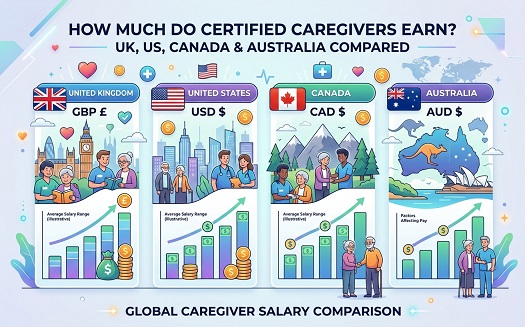
If you're considering a career in caregiving, salary is almost certainly one of your first questions — and it should be. Caregiving is demanding, emotionally meaningful work, and it's completely reasonable to want a clear picture of what you can realistically earn before you commit time and money to training.
The honest answer is that caregiver pay varies significantly depending on where you work, what setting you work in, how much experience you have, and — importantly — whether you're certified. This guide breaks down real caregiver salary data across the UK, US, Canada, and Australia, and explains exactly how certification affects your earning potential in each market. If you'd rather start building toward a higher salary right away, you can browse accredited caregiving courses here.
Why Caregiver Salaries Vary So Much
Before diving into country-by-country numbers, it's worth understanding the factors that consistently drive pay differences within the caregiving profession, since these matter as much as which country you're in:
- Care setting — private home care, residential facilities, hospitals, and live-in arrangements all pay differently, with private and specialised care often commanding a premium
- Certification and training level — a beginner certificate versus a full diploma covering dementia care, chronic condition management, and complex needs can meaningfully shift your pay band
- Experience and tenure — caregiving, like most professions, rewards proven reliability and track record over time
- Region and cost of living — urban centres and higher cost-of-living areas typically pay more across every country covered here
- Employment type — agency work, direct employment, and self-employment each carry different pay structures and benefits
- Specialisation — dementia care, palliative care, and complex medical needs support routinely pay above general caregiving rates
With that context, let's look at what certified caregivers actually earn in each of the four countries most commonly researched by people exploring this career path.
Caregiver Salaries in the UK
The UK care sector offers one of the more accessible entry points into paid caregiving work anywhere in the world, with pay typically increasing steadily alongside experience and additional certification.
Entry-level caregivers in the UK typically start in the £20,000–£25,000 per year range for full-time domiciliary or residential roles, according to the government's own National Careers Service care worker profile, which places typical starting pay around £20,000 rising to roughly £25,000 with experience.
Experienced and specialised caregivers — particularly those with dementia care training, complex needs experience, or several years in the field — routinely earn above this entry band, especially in private care, live-in arrangements, or senior care worker positions.
Private and live-in carers in the UK often command noticeably higher effective pay than institutional roles, particularly when working directly for families rather than through an agency, since accommodation and meals are frequently included as part of the arrangement.
Health care assistants, a closely related but more clinically involved role, typically start slightly higher than general caregiver positions, often in the £24,000–£27,000 range, reflecting their more structured, often NHS-affiliated work environment.
Across all of these bands, certification plays a consistent role: candidates who arrive with a recognised caregiving certificate or diploma are far better positioned to negotiate at the higher end of these ranges from day one, rather than starting at the absolute entry point and waiting years to catch up.
Caregiver Salaries in the United States
The US caregiving market — commonly categorised under "home health and personal care aides" — is large, fast-growing, and shows some of the widest regional pay variation of any country covered here.
According to the U.S. Bureau of Labor Statistics' Occupational Outlook Handbook for home health and personal care aides, the median annual wage for this occupation sits in the low-to-mid $30,000s nationally, with the profession projected to grow much faster than average due to the country's ageing population and expanding demand for home-based care.
Regional variation is significant. States with higher costs of living — California, New York, Washington, and Massachusetts among them — consistently report meaningfully higher median hourly rates than lower-cost states in the South and Midwest, sometimes by a difference of several dollars per hour.
Certified nursing assistants (CNAs) and formally trained caregivers typically out-earn uncertified entry-level aides by a noticeable margin, since certification demonstrates the baseline competency many US employers — particularly certified home health and hospice agencies — require or strongly prefer before hiring.
Specialised and agency-based caregivers, particularly those working with hospice, complex medical needs, or premium private-pay clients, frequently earn above the national median, with some experienced, well-certified caregivers earning well into the $40,000s or higher annually in high-demand metro areas.
For anyone comparing this to international opportunities, it's worth noting that the US market places particularly strong weight on documented, verifiable training — making an internationally recognised caregiving certification a genuinely useful credential for candidates entering this market from abroad, or for US-based learners competing in areas with many applicants.
Caregiver Salaries in Canada
Canada's caregiving sector — officially classified under "home support workers, caregivers and related occupations" — offers strong, government-tracked wage transparency, making it one of the clearer markets to research before committing to a career move.
According to Canada's Job Bank wage and labour market data, the median hourly wage for home support workers nationally sits at roughly $20 per hour, translating to a solid full-time annual income once regular hours are factored in.
Provincial variation is substantial. British Columbia and Ontario typically report some of the higher median wages in this occupation, while Atlantic Canada provinces such as New Brunswick and Newfoundland and Labrador tend to sit toward the lower end of the national range. Canada's northern territories — Yukon, Northwest Territories, and Nunavut — frequently report the highest wages of all, reflecting the higher cost of living and labour shortages in those regions.
Personal support workers (PSWs), a closely related and often interchangeable role with formal provincial certification requirements in some provinces, tend to command competitive rates within this same general range, with formally trained and certified workers positioned at the higher end of local pay bands.
Certification remains a strong differentiator in the Canadian market specifically because several provinces have moved toward requiring or strongly preferring standardised training for home care roles, meaning a recognised caregiving certificate or diploma can be the difference between qualifying for higher-paying, more structured agency positions versus being limited to informal, lower-paying arrangements.
Caregiver Salaries in Australia
Australia's aged and disability care sector — classified as "Aged and Disabled Carers" in national labour statistics — offers some of the more robust wage data of any country in this comparison, thanks to detailed government tracking of the occupation.
According to Jobs and Skills Australia's occupation profile for aged and disabled carers, median full-time weekly earnings for this occupation sit in the range of roughly $1,300–$1,800 per week depending on the data period referenced, which annualises to a solid full-time income comparable to, or exceeding, many other entry-accessible occupations in the Australian labour market.
Certificate III and IV qualifications are the standard entry credential in the Australian aged and disability care sector, with the large majority of the workforce holding one of these vocational qualifications — making formal training the norm rather than the exception in this market, and effectively a practical requirement for competitive employment.
Regional and employer variation is meaningful, with rates often ranging from around $30 to over $40 per hour depending on the employer, location, shift loading (evenings, weekends, and public holidays typically pay a premium under Australian industrial awards), and level of experience or specialisation.
Disability support work, closely related to aged care, frequently offers comparable or slightly higher pay, particularly for workers with additional training in complex support needs or behaviour support.
Because Australia's care sector places such strong emphasis on formal qualifications as a baseline expectation, arriving in this market — whether as a local candidate or someone considering relocation — without a recognised caregiving certification puts you at a significant competitive disadvantage compared to nearly every other applicant.
Comparing Take-Home Value, Not Just Headline Numbers
Raw salary comparisons across countries can be misleading if you stop at the headline figure alone, since cost of living, taxation, and typical benefits differ substantially between the UK, US, Canada, and Australia. A few important nuances worth factoring in:
Currency and purchasing power matter more than the number itself. A caregiver salary quoted in Australian or Canadian dollars looks different once converted and compared against local living costs than it does as a raw figure on a page. Before assuming one country "pays more," it's worth checking a current cost-of-living comparison for the specific cities or regions you're considering, since urban and rural pay and living costs can vary enormously within a single country.
Healthcare and benefits structures differ significantly. In the UK and Canada, employer-provided health coverage matters less to overall compensation, since both countries offer public healthcare systems. In the US, employer-sponsored health insurance can represent a substantial part of total compensation, meaning a slightly lower base salary with strong benefits may outperform a higher salary with minimal benefits once healthcare costs are factored in. Always ask about benefits, not just base pay, when comparing offers.
Superannuation and pension contributions add real value in Australia and the UK. Australia's compulsory superannuation guarantee adds a meaningful percentage on top of base salary that doesn't always appear in headline pay figures, while UK workplace pension contributions function similarly, adding to your effective total compensation beyond take-home pay alone.
Overtime, shift loading, and penalty rates can substantially boost real earnings. This is especially pronounced in Australia, where evening, weekend, and public holiday shifts often carry meaningful pay premiums under industrial awards — meaning two caregivers with identical base rates can have very different actual take-home pay depending on their shift patterns.
Tax treatment varies, particularly for self-employed and live-in arrangements. Private and live-in caregivers, especially in the UK and Canada, sometimes work under self-employed or informally arranged terms that carry different tax obligations than standard employment — always clarify this before accepting an offer, since it directly affects your real take-home income.
Beyond Salary: Other Forms of Compensation Worth Considering
Salary is the headline number, but several other factors materially affect the overall value of a caregiving role, and are worth weighing alongside pay when comparing opportunities:
- Accommodation and meals included, common in live-in caregiving arrangements, can represent a substantial hidden addition to your effective compensation, particularly in high-cost cities
- Paid training and ongoing professional development, offered by more established employers, reduces your own future certification costs and supports faster progression
- Travel allowances and mileage reimbursement, especially relevant for domiciliary and home care roles requiring travel between multiple clients
- Flexible scheduling, which while not direct compensation, has genuine financial value for caregivers balancing family responsibilities or additional work
- Career progression support, including employer-sponsored pathways toward senior or specialised roles, which affects your medium-term earning trajectory far more than any single year's salary
When comparing offers or planning your career path across any of these four countries, it's worth evaluating total compensation and career trajectory together, rather than focusing exclusively on the first year's base salary figure.
How Certification Actually Moves the Needle on Your Pay
Across all four countries, one pattern holds consistently: certification doesn't just help you get hired faster — it measurably affects where you land within the available pay range. Here's how that plays out in practice:
It removes the "unproven" discount. Uncertified candidates, especially those with limited prior paid care experience, are frequently offered pay at or near the absolute entry point of a role's range, since employers have no documented evidence of competency to justify anything higher. A recognised certificate removes much of that uncertainty from the negotiation.
It opens access to higher-paying settings. Private clients, specialised care roles, and agency positions with premium clients frequently specify or strongly prefer candidates with formal training — settings that general, uncertified entry-level roles typically can't access at all.
It shortens the time to your first pay rise. Certified caregivers often progress into senior or specialised roles faster, since they arrive with a documented foundation that would otherwise take months of on-the-job learning to build.
It supports salary negotiation directly. Being able to point to a specific, verifiable credential — rather than simply asserting "I'm a fast learner" — gives you concrete leverage in a pay conversation, particularly with private employers who have no internal pay scale to fall back on.
A full diploma extends this advantage further than a basic certificate. Comprehensive training covering dementia care, complex condition management, and end-of-life support positions you for the specialised roles that consistently pay above general caregiving rates in every market covered in this guide.
Demand Outlook: Why Pay Is Likely to Keep Rising in All Four Markets
Understanding current pay is useful, but so is understanding where these markets are heading, since strong demand growth typically supports upward pressure on wages over time.
In the UK, an ageing population combined with well-documented workforce shortages in social care means demand for trained carers remains consistently strong, with sector bodies regularly highlighting recruitment and retention as ongoing challenges — a dynamic that generally favours certified candidates able to demonstrate readiness quickly.
In the US, the Bureau of Labor Statistics projects employment growth for home health and personal care aides considerably faster than the average for all occupations over the coming decade, driven by an ageing population and a strong policy and consumer shift toward home-based rather than institutional care. Faster-than-average growth in a workforce this large typically translates into sustained hiring demand and, over time, upward wage pressure, particularly for trained and certified workers.
In Canada, government labour market data consistently flags home support and personal care roles among occupations with strong medium-term job prospects, reflecting both an ageing population and provincial policy pushes toward expanding home and community care capacity.
In Australia, the aged care sector has seen significant policy attention and funding reform in recent years aimed at improving both care quality and workforce conditions, with formal qualifications like Certificate III and IV increasingly treated as standard expectations rather than optional extras — a trend that continues to reward candidates who arrive already certified.
Taken together, these trends suggest that the case for certification isn't just about your first job — it's about positioning yourself early within a sector that's growing steadily across all four of these major English-speaking care markets, with training and qualifications playing an increasingly central role in who accesses the best-compensated opportunities as that growth continues.
Certificate vs. Diploma: Which Has a Bigger Impact on Pay?
This is worth addressing directly, since it's one of the most practical decisions facing anyone starting out.
A beginner certificate in caregiving is usually enough to enter the profession and access entry-level pay across the UK, US, Canada, and Australia. It demonstrates foundational competency and removes the biggest barrier facing uncertified applicants: a total lack of documented training.
A full diploma in caregiving — covering dementia support, personal care, chronic condition management, and end-of-life care — positions you for the roles that consistently sit above entry-level pay in every market: specialised private care, dementia-focused positions, and senior care roles that come with meaningfully higher compensation.
If your goal is simply to start earning as quickly as possible, a beginner certificate is a reasonable, cost-effective starting point. If your goal is to maximise your earning potential from the outset — or you're already planning to specialise — investing the additional time in a full Diploma in Caregiving tends to pay for itself quickly through access to better-compensated roles.
The Caregiver Pay Progression Ladder
Regardless of country, caregiver earnings tend to follow a fairly consistent progression pattern as experience and additional training accumulate:
Entry-level, general caregiving — the starting point for most new entrants, typically accessible with a beginner certificate and little to no prior paid experience.
Experienced general caregiver — after one to two years of consistent, reliable work, pay typically rises modestly even without additional formal training, reflecting proven reliability.
Specialised caregiver (dementia, palliative, complex needs) — a meaningful pay step up, usually requiring additional certification beyond the basic entry credential, such as a full diploma covering these specific areas.
Senior carer or team leader — combines experience with some supervisory or coordination responsibility, typically requiring several years in the field plus a demonstrated track record.
Care coordinator or registered manager track — the highest tier accessible without pursuing a fully regulated clinical qualification, usually requiring substantial experience, strong administrative and leadership skills, and often additional formal training in care management.
Certification accelerates movement through this ladder at every stage — not by skipping steps, but by providing the documented foundation that makes each subsequent step credible to employers evaluating your readiness for more responsibility and pay.
How Working Internationally Affects Your Earning Potential
One factor worth considering carefully, especially if you're early in your caregiving career: your certification's international recognition directly affects whether you can access higher-paying markets later, without starting your training over from scratch.
A carer trained and certified only within a narrow, locally recognised scheme may find that certification carries little weight if they later relocate or seek agency placements in a different country. By contrast, a certificate from a provider recognised across multiple countries — as is the case with MS Caregivers Academy, certified by the American Caregiver Association, the Australian Department of Health and Aged Care, and NHS England — remains valid and verifiable regardless of which of these markets you eventually work in.
Given the meaningful pay differences between regions even within a single country, let alone between the UK, US, Canada, and Australia, this portability isn't a minor convenience — it's a real factor in your long-term earning potential, especially if international care work or relocation is even a modest possibility for your future.
Practical Ways to Increase Your Caregiver Salary
Beyond simply getting certified, several concrete steps consistently correlate with higher caregiver pay across all four markets covered in this guide:
Pursue specialisation early. Dementia care, palliative and end-of-life support, and complex chronic condition management are consistently among the better-compensated specialisations within general caregiving, and formal training in these areas differentiates you quickly.
Consider private and live-in arrangements. Where you're comfortable with the working arrangement, private clients often pay more directly than institutional employers, particularly when accommodation or other benefits are factored in.
Build a documented track record deliberately. Ask satisfied clients or employers for references proactively, and keep a clear record of your responsibilities and any positive outcomes you've contributed to — this becomes powerful negotiating material at review time.
Layer additional certifications over time. Starting with a beginner certificate and later adding a full diploma, or specialised modules like emergency and crisis response training, builds a credential profile that supports steady pay progression rather than a single static qualification.
Negotiate directly, especially in private arrangements. Many caregivers, particularly in private and live-in roles, under-negotiate simply because there's no formal pay scale to reference — bring market data (like the figures in this guide) into that conversation confidently.
Stay current with continued professional development. In a sector explicitly built around ongoing training, caregivers who keep learning — rather than treating their first certificate as a one-time achievement — remain the most competitive for pay increases and promotions over time.
Frequently Asked Questions
Do certified caregivers really earn more than uncertified ones? Yes, consistently across all four countries covered in this guide. Certification typically shortens the path to higher starting pay, opens access to better-compensated specialised and private roles, and supports stronger negotiating positions than uncertified candidates typically have.
Which country pays caregivers the most? Direct comparison is difficult due to differing costs of living, currencies, and benefit structures, but Australia's formally regulated, qualification-based aged care sector and the higher end of the US private-pay market both tend to offer strong compensation relative to entry requirements, while the UK and Canada offer more accessible entry points with steady progression potential.
Is it worth getting a full diploma instead of just a beginner certificate? If your goal is to maximise earning potential and access specialised or higher-paying roles sooner, yes. A full Diploma in Caregiving typically pays for itself through better-compensated opportunities that a basic certificate alone doesn't unlock.
Does an online certification actually affect real-world pay negotiations? Yes, particularly with private employers and smaller agencies that lack formal pay scales. A recognised, verifiable certificate gives you concrete material to reference in a pay conversation, rather than relying solely on subjective impressions from an interview.
How quickly can certification affect my income? Since most online caregiving certifications take just a few weeks to complete, the earning impact can begin almost immediately — certified candidates frequently secure their first paid role, and often at a higher starting rate, faster than uncertified applicants competing for the same positions.
Should I choose my training provider based on where I might eventually want to work? It's worth considering. If there's any realistic chance you'll want to work internationally, choosing a provider with recognised accreditation across multiple countries protects the value of your certification regardless of where your career eventually takes you.
Does the type of client or setting affect pay as much as certification does? Both matter, but they work together rather than independently. Certification is often what determines whether you can access higher-paying settings like private live-in care or specialised dementia support in the first place — without it, many of the better-compensated opportunities in every market covered here simply aren't available to you regardless of your enthusiasm or informal experience.
Is it better to specialise early or gain general experience first? Both approaches can work, but building a strong general foundation through a comprehensive diploma before specialising tends to serve caregivers well across all four countries, since specialised roles typically still expect solid grounding in core caregiving skills, communication, and safeguarding before layering on condition-specific expertise.
Final Thoughts: Certification Is an Investment in Your Earning Potential
Across the UK, US, Canada, and Australia, the pattern is remarkably consistent: caregiving offers a genuinely accessible entry point into paid, meaningful work, and certification is one of the clearest, fastest ways to move beyond entry-level pay toward the specialised, private, and senior roles that consistently compensate better. The specific numbers vary by country and region, but the underlying principle doesn't — documented, verifiable training translates directly into stronger job offers and better pay negotiations, regardless of where you're based.
If you're ready to start building toward a stronger caregiving salary, you can create a free account and explore the Certificate and Diploma in Caregiving courses here — internationally recognised training designed to open doors, not just in your local job market, but wherever your caregiving career eventually takes you.
Ready to invest in your earning potential? Visit MS Caregivers Academy to start your Continued Professional Development journey today.