
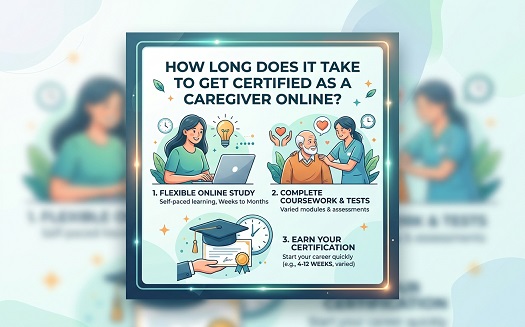
If you're weighing up a career in caregiving, timing is probably one of your biggest practical questions. Maybe you need income soon and can't afford to spend months studying before you can apply for work. Maybe you're balancing an existing job or family responsibilities and need to know exactly how much time you're committing to before you enrol. Either way, "how long will this actually take?" deserves a direct, honest answer — not a vague marketing promise.
Here's the short version: a beginner certificate in caregiving can typically be completed in one to two weeks of consistent part-time study, while a full diploma in caregiving usually takes four to eight weeks. But the real answer depends on several factors specific to you — how many hours you can realistically dedicate each week, which course level you choose, and how quickly you move through assessments. This guide breaks all of that down in detail, so you can plan your certification timeline with confidence and start applying for jobs as soon as you're genuinely ready — beginning with the online caregiving courses available here.
The Short, Direct Answer
Before getting into the details, here's the headline timeline for the most common caregiving course levels:
- Beginner Certificate in Caregiving (around 5 hours of content, 3 modules): typically 1–2 weeks of part-time study
- Full Diploma in Caregiving (around 26 hours of content, 10 modules): typically 4–8 weeks of part-time study
- Specialised courses such as Emergency Crisis Management (around 9 hours of content, 6 modules): typically 2–3 weeks of part-time study
These timelines assume realistic, sustainable part-time study — not an unrealistic all-consuming sprint, and not a comparison to multi-year college or university routes into healthcare and social care, which typically take considerably longer. Compared to almost any other route into paid, professional work, online caregiver certification is genuinely fast — but "fast" still means real weeks of focused study, not hours.
What Actually Determines Your Certification Timeline
Course length estimates are a useful starting point, but your actual timeline depends on several personal factors that are worth thinking through honestly before you enrol.
How many hours you can realistically commit each week
This is the single biggest variable. Someone able to dedicate 5–7 hours a week will move through a course considerably faster than someone squeezing in 1–2 hours around a full-time job and family responsibilities. Neither pace is wrong — but it's worth being honest with yourself about which one reflects your actual life right now, rather than an idealised version of your schedule.
Which course level you choose
As covered above, a beginner certificate's roughly 5 hours of content is inherently faster to complete than a diploma's roughly 26 hours, regardless of how quickly you personally study. This is simply a function of total course volume, not how capable you are as a learner.
Your existing familiarity with the material
If you've spent years as a family caregiver, some of the foundational content in a beginner certificate — or even parts of a diploma — may move faster for you than for someone encountering these concepts for the first time, since you're reinforcing and formalising knowledge you already partially hold rather than learning it from scratch.
How you handle assessments
Reputable online caregiving courses set a genuine pass mark (commonly 75%) and typically allow unlimited retakes. If you move through module content quickly but need a retake or two on specific assessments, this adds some time — but it's a normal, expected part of genuine learning, not a sign you're behind schedule.
Your study environment and consistency
Learners who study in short, focused, regular sessions — say, 30–45 minutes several times a week — tend to complete courses more reliably and retain more than those attempting infrequent, marathon study sessions. Consistency matters more than any single session's length.
A Realistic Week-by-Week Breakdown: Completing a Beginner Certificate
To make this concrete, here's what a typical, achievable path through a Beginner Certificate in Caregiving might look like for someone studying part-time around existing commitments.
Days 1–3: Complete module one, covering healthcare systems and how caregiving fits within them. At a pace of roughly 30–45 minutes a day, this typically covers the video lessons, slide content, and the module's short assessment comfortably within this window.
Days 4–6: Move into module two, covering professional standards and workplace conduct. Similarly paced sessions carry you through the material and its assessment.
Days 7–9: Complete the final module, covering essential caregiving skills and core communication techniques, along with its assessment.
Days 10–12: Review your notes across all three modules, then sit the comprehensive final examination. If you don't pass on your first attempt, use the unlimited retake policy to revisit specific weak areas rather than restarting the entire course.
Days 13–14: Receive your automatically generated certificate upon passing, and request a reference letter if your provider offers one.
This pacing — roughly 30–45 minutes on most days over a two-week window — comfortably delivers a genuinely earned beginner certificate without requiring you to pause work, family responsibilities, or other commitments.
A Realistic Week-by-Week Breakdown: Completing a Full Diploma
A Diploma in Caregiving, covering roughly 26 hours across ten modules, naturally takes longer, but the same principle of steady, consistent study applies.
Weeks 1–2: Cover the foundational modules shared with the beginner certificate — healthcare systems, professional standards, communication, and legal and ethical fundamentals — at a pace of around 45–60 minutes several times a week.
Weeks 3–4: Move into personal care protocols and safety and infection control procedures, modules that involve more hands-on, procedural content and may benefit from slightly longer study sessions to properly absorb.
Weeks 5–6: Study dementia support and chronic condition management, two of the diploma's more specialised modules, which often reward a bit of extra time given their real-world complexity and the likelihood you'll encounter these exact situations early in your caregiving career.
Week 7: Complete end-of-life and palliative care content, along with any remaining specialised modules, then begin reviewing across the full course.
Week 8: Sit the comprehensive final examination covering all ten modules. If needed, use retakes strategically, focusing your review on whichever specific areas the assessment reveals as weaker.
This eight-week structure assumes a moderate, sustainable pace of roughly 3–4 hours weekly. Learners with more available time each week — say, 6–8 hours — often complete the same diploma in closer to four to five weeks, while those with more limited time may reasonably take longer than eight weeks without this reflecting any deficiency in their learning.
How Online Certification Timelines Compare to Traditional Routes
It's worth putting these timelines in context against the alternatives, since "a few weeks" only sounds fast or slow relative to something else.
College-based health and social care courses in the UK often run for a full academic year or longer, following a fixed term structure with set start dates, scheduled class times, and a pace determined by the institution rather than the individual learner.
Apprenticeship routes into care-related roles typically span twelve months or more, combining structured off-the-job training with supervised on-the-job learning over an extended period.
Formal, regulated qualifications like a nursing associate pathway represent a multi-year commitment, reflecting the significantly greater scope and clinical accountability involved.
Against this backdrop, a self-paced online caregiver certification course completing in one to eight weeks represents a genuinely different category of time commitment — not because the content is less rigorous, but because it's delivered without the institutional scheduling overhead, fixed cohorts, and academic term structures that extend traditional routes considerably beyond the actual study time involved.
This pattern reflects a broader shift in how UK adults approach learning more generally. According to the Learning and Work Institute's ongoing research into adult participation in learning, nearly half of UK adults have taken part in some form of learning in recent years, with working adults increasingly favouring flexible, self-directed formats that fit around existing jobs and responsibilities rather than traditional, fixed-schedule courses — exactly the format online caregiver certification is built around.
The Full Timeline: From Enrolment to Your First Paid Shift
Certification itself is only one part of the total timeline before you're actually working and earning. Here's the fuller picture, since this is what genuinely matters if your goal is starting paid work as soon as possible.
Certification (1–8 weeks, depending on course level and pace). As detailed above, this is the portion of the timeline most within your direct control.
Job applications and interviews (variable, often overlapping with certification). You can begin researching and even applying to roles while completing your certification, particularly toward the end of your course, since many employers are willing to interview candidates who are close to completing their training.
Enhanced DBS check (typically around 14 days, sometimes longer). According to official UK government guidance on DBS checks for employees and volunteers, standard and enhanced checks usually take around 14 days, though this can extend if application details need correcting or if multiple police forces need to be involved. Helpfully, care sector employers can use a service called DBS Adult First, which can confirm within around two days whether a candidate can begin supervised work while the fuller enhanced check is still processing — meaning this step doesn't necessarily have to delay your start date entirely.
Employer onboarding and induction (typically a few days to a couple of weeks). Once hired, most employers run a short induction period covering their specific policies and procedures, alongside beginning the employer-led Care Certificate process where applicable.
Adding this up, a realistic total timeline from starting your certification to your first paid shift often falls somewhere between four and ten weeks for most learners — considerably faster than almost any other route into professional healthcare or social care work, even accounting for background checks and hiring processes outside your direct control.
How to Move Through Certification Efficiently, Without Cutting Corners
If your priority is completing certification as quickly as responsibly possible, here are genuinely effective strategies — as opposed to shortcuts that risk leaving you underprepared.
Study in short, frequent sessions rather than occasional long ones. Thirty to forty-five minutes several times a week is generally more effective for retention and completion than trying to find rare, multi-hour blocks of free time.
Treat module assessments as learning checkpoints, not obstacles to rush past. Genuinely understanding why you got a question wrong, rather than simply retaking until you pass by chance, actually speeds up your overall completion time by reducing the number of retakes needed on the comprehensive final exam.
Use natural pauses in your day. Commutes (if not driving), breaks between shifts in a current job, or quiet evening windows are often enough for a single module's video content, especially with courses designed for mobile-friendly, on-the-go study.
Take notes as you go, rather than relying on memory alone. This makes your final review before the comprehensive examination considerably faster and more focused, since you're revisiting your own summarised understanding rather than re-watching entire modules.
Choose the right course level for your actual goals from the start. Starting with a diploma when a beginner certificate would meet your immediate needs — or vice versa — can add unnecessary time. Reviewing course options and content in detail before enrolling helps you commit to the right level the first time.
Set a realistic personal deadline and treat it seriously. Self-paced learning's flexibility is a genuine advantage, but without some self-imposed structure, it can also allow procrastination to extend a course indefinitely. A specific target date — even an informal one — meaningfully improves completion speed for most learners.
Common Reasons People Take Longer Than Expected
Understanding why some learners' timelines stretch beyond the typical range can help you avoid the same pitfalls.
Underestimating competing demands on their time. Life doesn't pause for a course, and unexpected work shifts, family needs, or health issues can genuinely extend a timeline — this is normal, and self-paced courses are specifically designed to accommodate this kind of real-world unpredictability rather than penalise it.
Studying inconsistently rather than regularly. Long gaps between study sessions often mean re-familiarising yourself with earlier material before continuing, which adds time compared to steady, regular engagement.
Treating assessments as a formality rather than genuine learning checkpoints. Learners who skim content specifically to "get through" a quiz, rather than engaging with the material itself, often need more retakes than those who study with genuine understanding as the goal — ultimately taking longer overall despite moving faster through the content initially.
Choosing the wrong course level for their starting point. Someone with no prior caregiving exposure attempting to rush through diploma-level specialised content without a solid foundation may need to revisit earlier material more than expected.
Waiting for a "perfect" uninterrupted block of time that never arrives. As covered above, this is one of the most common, avoidable reasons a course stretches on far longer than its actual content requires.
None of these reasons reflect poorly on a learner — they're simply common, addressable patterns worth being aware of as you plan your own approach.
Setting a Realistic Personal Timeline
Rather than relying solely on generic course-length estimates, it's worth mapping out your own realistic timeline before you enrol. Consider:
- How many hours per week can you genuinely, sustainably commit — not in an ideal world, but in your actual current life?
- Which course level matches your immediate goals: fastest possible entry into work, or a more comprehensive foundation from the outset?
- Do you have any flexibility to increase your study hours temporarily if you need to accelerate toward a specific target date, such as an upcoming financial deadline or a job opportunity with a start date in mind?
- Are you factoring in the full picture — certification plus DBS processing plus employer onboarding — rather than certification time alone, if your goal is a specific "start working by" date?
Answering these questions honestly before you begin gives you a personal, realistic timeline rather than relying purely on generic course-length averages that may not reflect your specific circumstances.
How Your Life Situation Affects Your Realistic Timeline
Generic course-length estimates are useful starting points, but your actual completion time is shaped heavily by which of the following situations most closely matches your own circumstances.
If you're currently unemployed and job-hunting full-time. You likely have more available hours than most learners, and treating certification as your primary daily focus can genuinely compress a beginner certificate into well under a week, or a diploma into three to four weeks, without sacrificing depth of learning.
If you're working full-time in an unrelated job. Evenings and weekends become your primary study windows. A realistic pace here is often three to five hours weekly, placing you toward the middle or slightly longer end of the typical ranges — a beginner certificate in around two weeks, a diploma in six to eight.
If you're a parent or primary caregiver for children. Study time often has to fit into unpredictable pockets — nap times, after bedtime, or school hours. This doesn't necessarily mean a slower pace overall, but it often means less predictable, more fragmented sessions, so building in some flexibility around your personal deadline is worth planning for from the outset.
If you're already working informally or part-time in care. You may find foundational content moves faster than expected, since you're reinforcing rather than learning from scratch, potentially shortening your realistic timeline compared to someone with no prior exposure to the material.
If you're managing a health condition or caring for a family member yourself. Energy and available time may vary considerably day to day. Self-paced online courses accommodate this well precisely because there's no fixed schedule to fall behind on — building in extra buffer time against the "typical" range is a sensible, realistic approach rather than a sign of struggling.
Recognising which of these situations describes you helps set expectations that are genuinely achievable, rather than comparing yourself to a generic average that may not reflect your actual circumstances.
A Simple Time-Budgeting Worksheet for Your Own Timeline
Before enrolling, it can help to work through a few numbers concretely rather than relying on impressions alone.
Step 1: Identify your genuinely available weekly study hours. Look honestly at your week — not the hours you wish you had, but the ones you can consistently protect without constant disruption. Write this number down.
Step 2: Divide your chosen course's total hours by your weekly availability. A beginner certificate's roughly 5 hours divided by, say, 3 available hours weekly gives you a realistic completion estimate of just under two weeks. A diploma's roughly 26 hours divided by the same 3 weekly hours points toward roughly nine weeks — useful information for setting expectations before you start, rather than partway through when frustration might otherwise set in.
Step 3: Add a buffer for assessments and review. Build in an additional 10–20% of your total estimated time to account for module quizzes, any retakes, and final review before your comprehensive examination — this keeps your target realistic rather than optimistic.
Step 4: Set a specific target completion date, not just a vague intention. A concrete date — written down, ideally shared with someone who can help hold you accountable — meaningfully improves follow-through compared to an open-ended "sometime in the next couple of months" approach.
Step 5: Revisit and adjust after your first week. Your first week of actual studying will tell you more about your realistic pace than any estimate can in advance. If you're moving faster or slower than planned, adjust your target date accordingly rather than treating the original estimate as fixed.
This simple planning exercise takes only a few minutes but significantly improves the accuracy of your expectations, and in turn, your motivation to actually follow through on a timeline you've set for yourself.
Myths About Certification Speed, Debunked
"If a course can be finished quickly, it must not teach much." Course length reflects the scope of content covered, not the seriousness of the assessment behind it. A focused beginner certificate covering essential caregiving fundamentals in around 5 hours can be just as rigorously assessed as a longer course — it simply covers less ground by design.
"Everyone should aim to finish as fast as humanly possible." Speed is only valuable insofar as it doesn't come at the cost of genuine understanding. Since caregiving involves real responsibility for vulnerable people from your very first shift, rushing through material without absorbing it serves no one well, including you.
"Taking the full eight weeks for a diploma means I'm a slow learner." The eight-week estimate reflects a moderate, sustainable pace suitable for someone balancing existing commitments — it says nothing about your learning ability, and many learners with legitimate time constraints reasonably take even longer without any reflection on their competence.
"Online courses take longer than in-person ones because there's no teacher pushing you along." In practice, the opposite is usually true. Fixed-schedule, in-person courses are bound by term dates, class timetables, and institutional pacing that often extends far beyond the actual instructional content involved — self-paced online courses remove exactly this overhead.
"I need to finish before I can start looking for jobs at all." As covered earlier, many learners successfully begin researching roles and even interviewing before their certification is fully complete, particularly in the final stretch of their course.
Frequently Asked Questions
What's the fastest I could realistically complete a beginner certificate? With a strong, consistent daily study commitment of an hour or more, some highly motivated learners complete a beginner certificate in under a week. For most people balancing existing responsibilities, one to two weeks is a more realistic and sustainable target.
Is it possible to complete a diploma faster than eight weeks? Yes, particularly for learners able to dedicate 6–8 hours weekly, or those with substantial prior caregiving experience who move through foundational content more quickly. Four to five weeks is achievable for many learners under these conditions.
Does a faster completion time mean lower-quality certification? Not necessarily. What matters is whether genuine assessment — module quizzes and a comprehensive final examination with a real pass mark — sits behind your certificate, not simply how many calendar weeks elapsed while you studied.
Can I start applying for jobs before I finish my certification? Yes, and many learners do exactly this, particularly toward the end of their course, since employers are often willing to interview candidates who are close to completing their training and can confirm an expected completion date.
How does the DBS check affect my overall timeline to start working? An Enhanced DBS check typically takes around 14 days once your employer initiates it after a job offer, though services like DBS Adult First can sometimes allow supervised work to begin sooner while the fuller check completes.
Should I choose the beginner certificate or the diploma if I'm short on time right now? If your primary constraint is time and you need to start applying for jobs as quickly as possible, the Beginner Certificate in Caregiving is the faster route. You can always build toward a full diploma once you're established in a paid role.
What happens if I don't finish within the "typical" timeframe? Nothing negative — self-paced online courses are specifically designed to accommodate learners moving at different speeds. Taking longer than the typical range doesn't affect the validity or quality of your eventual certificate.
Final Thoughts: A Realistic Timeline You Can Actually Plan Around
The honest answer to "how long does it take to get certified as a caregiver online" is genuinely encouraging: for most learners, it's a matter of one to eight weeks, not months or years — a fraction of the time required by traditional college or apprenticeship routes into care work. The exact figure within that range depends on which course level you choose and how much time you can realistically, sustainably commit each week, but either way, you're looking at a timeline measured in weeks that fits around an existing job, family responsibilities, or other commitments, rather than requiring you to pause your life to pursue it.
If you're ready to start your own countdown, you can create a free account and explore the Certificate and Diploma in Caregiving courses here — with self-paced modules, instant auto-graded assessments, and a certificate generated the moment you pass, so your timeline is genuinely in your own hands.
Ready to find out exactly how soon you could be certified? Visit MS Caregivers Academy to start your Continued Professional Development journey today.