
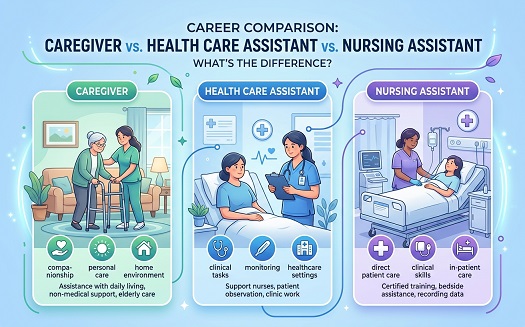
If you've been researching a career in care, you've almost certainly run into these three job titles used interchangeably — sometimes even within the same job advert. "Caregiver," "health care assistant," and "nursing assistant" sound similar, often involve similar day-to-day tasks, and are frequently listed as "alternative titles" for one another on job boards. That overlap is exactly why so many people considering this field end up asking the same question: what's actually the difference, and which one should I train for?
The honest answer is that the lines between these roles are blurrier in practice than they are on paper — but there are real, meaningful differences in training requirements, regulation, scope of practice, pay, and career progression. Understanding those differences before you enrol in a course or apply for a job will save you time, help you target the right training, and put you on a clearer path toward the care career you actually want.
This guide breaks down each role in detail, compares them side by side, and shows you exactly how to get certified for whichever path fits your goals — including where you can start an accredited online caregiving course today.
Why the Confusion Exists in the First Place
Before comparing the roles individually, it helps to understand why the terminology is so inconsistent across the care sector:
- Job titles vary by employer, not by law. Because most of these roles sit within the UK's non-regulated care workforce, employers are free to call a role whatever they like. One care home's "care assistant" may do exactly the same job as another facility's "health care assistant."
- Regional and international differences add another layer. In the US, "caregiver" and "certified nursing assistant (CNA)" are common terms; in the UK, "care worker" and "health care assistant" dominate; in Australia, "aged care worker" is widely used. The underlying work often overlaps significantly.
- Career progression blurs the boundaries further. Many people move fluidly between these titles over the course of a single career, picking up more training and responsibility as they go, which makes the roles feel more like points on a spectrum than fixed, separate jobs.
With that context in mind, let's look at what actually distinguishes a caregiver, a health care assistant, and a nursing assistant — starting with the role most people enter the profession through.
What Is a Caregiver?
A caregiver (also called a care worker, support worker, or personal care assistant) provides non-clinical, day-to-day support to people who need help with daily living — most commonly older adults, people with disabilities, or those recovering from illness or surgery.
Typical caregiver responsibilities include:
- Assisting with personal care: bathing, dressing, grooming, and toileting
- Helping with mobility and preventing falls
- Preparing meals and supporting proper nutrition
- Providing companionship and emotional support
- Light housekeeping and running errands
- Medication reminders (though usually not administering medication directly, depending on training and employer policy)
- Monitoring and reporting changes in a client's condition to family or supervising staff
Where caregivers typically work:
- Private homes (domiciliary/home care)
- Residential care homes
- As live-in carers for a single client
- Informally, as family caregivers who later choose to formalise their experience through certification
Training and certification for caregivers:
This is where caregiving stands apart from the other two roles: you generally don't need a healthcare qualification, prior clinical experience, or a college degree to start. Most caregivers enter the field through a structured online caregiver certification course covering healthcare fundamentals, professional standards, communication, safeguarding, and hands-on care skills. Because there's no single national licence required before you start working, the quality of your training depends entirely on choosing a properly accredited course — which is also what makes independent, internationally recognised certification so valuable in this role specifically.
A Beginner Certificate in Caregiving is usually enough to enter the field, while a full Diploma in Caregiving — covering dementia support, personal care, chronic condition management, and end-of-life care — prepares you for more advanced or specialised caregiving roles, including work with clients who have complex needs.
What Is a Health Care Assistant (HCA)?
A health care assistant typically works in a more clinically integrated environment than a general caregiver — most often in hospitals, GP surgeries, or NHS-affiliated care settings, though many also work in nursing and residential homes. HCAs support registered nurses and other clinical staff with both personal care and basic clinical tasks.
Typical HCA responsibilities include:
- Everything included in general caregiving (personal care, mobility support, meals)
- Taking and recording clinical observations: temperature, pulse, blood pressure, and breathing rate
- Assisting nurses with clinical procedures under supervision
- Helping patients move safely between departments or wards
- Supporting infection control protocols in clinical settings
- Communicating changes in patient condition directly to nursing staff
Where HCAs typically work:
- Hospitals and hospital wards
- GP surgeries and clinics
- NHS-affiliated care settings
- Nursing homes with a more clinical care model
Training and certification for health care assistants:
HCAs typically need a broader, more clinically oriented training foundation than an entry-level caregiver, even though — like caregiving — the role remains part of the non-regulated workforce. Many HCAs begin with caregiver-level certification and then build on it with modules covering clinical observations, infection control, and healthcare systems. According to the UK government's own National Careers Service healthcare assistant profile, people typically enter this role through a college course, an apprenticeship, or by working up into it from an entry-level care position — all of which benefit from arriving with a recognised caregiving certificate already in hand, since it demonstrates the foundational competencies employers expect before offering on-the-job clinical training.
This is one of the clearest reasons a Diploma in Caregiving is worth considering even if your ultimate goal is an HCA role: it builds the exact foundation — professional standards, communication, safety, and condition-specific care knowledge — that HCA employers look for in candidates before they invest in further clinical training.
What Is a Nursing Assistant?
"Nursing assistant" is where terminology gets genuinely inconsistent across regions, so it's worth separating two very different things that sometimes share this name:
1. Nursing assistant as an informal job title — In many UK job listings, "nursing assistant" is used interchangeably with "health care assistant" or "care assistant," referring to unregulated support staff working alongside nurses. If you see this title in a UK care home job advert, it usually describes essentially the same role as an HCA.
2. Nursing associate as a regulated profession — This is a distinct, formally regulated role introduced to bridge the gap between unregulated care staff and fully registered nurses. Nursing associates complete a structured, longer training programme (often a foundation degree or apprenticeship) and are registered with, and regulated by, the Nursing and Midwifery Council (NMC) — the same body that regulates registered nurses and midwives in the UK.
Typical nursing assistant / nursing associate responsibilities include:
- Everything included in HCA duties
- More advanced clinical tasks performed with greater autonomy, depending on registration level
- Contributing to care planning under the direction of a registered nurse
- Acting as a bridge between unregistered care staff and the clinical nursing team
- For registered nursing associates specifically: legally accountable clinical practice within their scope, similar in principle to (but more limited than) a registered nurse's
Where nursing assistants typically work:
- Hospitals, especially wards with higher clinical need
- Nursing homes
- Community health teams
- GP practices and integrated care settings
Training and certification for nursing assistants:
This is the most significant divergence between the three roles. Unlike caregiving and most HCA positions, becoming a registered nursing associate requires completing an approved, regulated training programme (typically an apprenticeship or foundation degree pathway) and formally joining the NMC register. This is not something you can complete through a short online certification course — it's a multi-year regulated qualification with legal accountability attached.
However, if you're using "nursing assistant" more loosely to describe an unregulated support role (which is common in general job advertising), the training path looks much closer to an HCA's: a strong caregiving foundation, ideally supplemented with more clinically focused modules, positions you well to move into these roles and progress toward formal nursing associate training later if you choose to.
Caregiver vs. HCA vs. Nursing Assistant: The Core Differences
Here's a clear breakdown of what actually separates these three roles once you strip away the inconsistent job titles:
Regulation
- Caregiver: Non-regulated; no legally mandated licence to start
- Health Care Assistant: Non-regulated, though often trained to align with NHS and clinical standards
- Nursing Assistant (as "nursing associate"): Formally regulated by the NMC if pursuing full registration; unregulated if used as an informal HCA-equivalent title
Typical work setting
- Caregiver: Private homes, residential care, live-in care
- Health Care Assistant: Hospitals, GP surgeries, NHS-affiliated settings, nursing homes
- Nursing Assistant: Hospitals, nursing homes, community health teams, integrated clinical settings
Scope of practice
- Caregiver: Non-clinical daily living support
- Health Care Assistant: Personal care plus basic clinical observations and supervised clinical tasks
- Nursing Assistant/Associate: Broader clinical involvement, with registered nursing associates holding legal accountability within a defined scope
Entry requirements
- Caregiver: Minimal; accredited online certification is often sufficient to start
- Health Care Assistant: Often requires broader training, sometimes a college course or apprenticeship, though many enter directly with strong caregiving certification
- Nursing Assistant (registered): Requires a formal, regulated training programme and NMC registration; informal "nursing assistant" titles require HCA-equivalent training
Typical starting salary in the UK
- Caregiver: Generally the most accessible entry point, with pay varying by employer and region
- Health Care Assistant: Typically higher than entry-level caregiving roles, reflecting the more clinical scope
- Nursing Assistant/Associate: Registered nursing associates typically earn more still, reflecting their formal qualification and regulated accountability
Career progression
- Caregiver: Can progress into senior carer, HCA, or specialised care roles (e.g. dementia care) with further training
- Health Care Assistant: Can progress into nursing associate training, specialist clinical support roles, or team leadership
- Nursing Assistant/Associate: Can progress toward registered nurse training through recognised bridging or "top-up" pathways
A Day in the Life: How the Three Roles Actually Compare
Job descriptions only tell you so much. Here's a more grounded look at what a typical shift actually feels like in each role, since day-to-day experience often matters more to job satisfaction than the title on your contract.
A typical caregiver's day usually centres on one or a small number of clients, often in a home setting. You might start the morning helping a client wash and dress, prepare and serve breakfast, support them with medication reminders, accompany them to a GP appointment or simply sit and talk over tea. The pace tends to be more personal and relationship-driven, since you're often working closely with the same individuals over weeks, months, or years. Emotional connection and consistency matter enormously in this role, and many caregivers describe it as feeling less like "a job" and more like an extension of family care, done professionally and with proper training behind it.
A typical health care assistant's day is usually structured around a ward, shift pattern, or clinic schedule, working alongside a wider clinical team. You might rotate between multiple patients, take and record observations, assist with meals and personal care across a caseload, escort patients between departments, and communicate frequently with nurses about changes in condition. The pace is often faster and more task-driven than home caregiving, with more built-in structure, supervision, and clinical protocol to follow.
A typical nursing assistant's day (in either the informal HCA-equivalent sense or as a registered nursing associate) blends elements of both — closer clinical involvement than a general caregiver, but often with more responsibility for contributing to care planning and liaising directly with the nursing team on treatment decisions. Registered nursing associates in particular will have a defined scope of clinical tasks they're accountable for performing independently, which shifts the day-to-day experience closer to that of a junior member of the nursing team than a support worker.
Thinking honestly about which of these day-to-day rhythms appeals to you — relationship-focused home care, structured clinical teamwork, or a blend with more clinical accountability — is often a better guide to the right starting role than salary comparisons alone.
The Soft Skills That Matter Across All Three Roles
Regardless of which path you choose, certain core skills matter across caregiving, HCA work, and nursing assistant roles alike. Employers consistently look for:
- Patience and emotional resilience — care work involves supporting people through vulnerable, sometimes distressing moments, often repeatedly across a single shift
- Clear communication — with clients, patients, families, and colleagues, often adjusting your communication style for cognitive impairment, hearing loss, or language barriers
- Attention to detail — small changes in a client's condition, mood, or behaviour often matter more than they first appear
- Reliability — care settings depend on consistent staffing, and unreliability directly affects vulnerable people's safety and wellbeing
- Physical stamina — all three roles involve time on your feet, assisting with mobility, and physically demanding tasks across long shifts
- Comfort with routine and repetition, balanced with adaptability — much of the daily structure repeats, but no two clients or patients are identical, and flexibility matters
A good online caregiver certification course should explicitly teach and assess these soft skills alongside technical knowledge — not just cover clinical facts — since they're often what separates a competent carer from an exceptional one in the eyes of employers, clients, and their families.
Which Role Should You Train For?
There's no universally "better" choice among these three roles — the right one depends entirely on your goals, timeline, and how much clinical responsibility you want to take on.
Choose the caregiver path if:
- You want to start working and earning as quickly as possible
- You're testing whether a care career is right for you before committing further
- You're formalising experience from family caregiving
- You want flexibility to work in private homes or independently, not just within institutional settings
Choose the health care assistant path if:
- You're drawn to a more clinical environment, like hospitals or GP surgeries
- You want a role with more variety in daily tasks, including basic clinical observations
- You're open to further training that could lead toward nursing in the future
- You don't mind working within a more structured, supervised team setting
Choose the nursing assistant / nursing associate path if:
- You're committed to a longer-term, more clinically advanced career
- You're comfortable pursuing a multi-year regulated qualification
- You want a role with formal legal accountability and a clear progression route into registered nursing
- You've already got experience as a caregiver or HCA and are ready for the next step up
The Most Common (and Smartest) Career Path: Start as a Caregiver
Here's something worth being direct about: most health care assistants and nursing associates didn't start there. The most common, and often the smartest, entry point into any of these three roles is caregiving — because it requires the least upfront commitment, gets you working and earning fastest, and gives you real, practical experience that makes every subsequent qualification easier to complete.
A typical progression looks like this:
- Complete an accredited online caregiver certification course — often a beginner certificate to start
- Gain hands-on experience in a home care, residential, or entry-level hospital support role
- Build on your foundation with a full Diploma in Caregiving, adding dementia care, condition-specific knowledge, and more advanced personal care skills
- Move into a health care assistant role, using your caregiving certification and experience to stand out against less-prepared applicants
- If you choose to go further, pursue formal nursing associate training through an approved apprenticeship or foundation degree pathway, using your years of practical care experience as a strong foundation
This path lets you earn while you learn, test your fit for clinical work before committing years to formal nursing training, and build a CV that shows consistent, deliberate progression rather than a cold start.
How Certification Differs Across the Three Roles
One of the most practical distinctions between these roles comes down to what kind of certificate actually helps you get hired.
For caregivers, an internationally recognised certificate from an accredited academy is often the single biggest factor separating a shortlisted candidate from one who gets overlooked — since there's no other formal barrier to entry, your certification does the work of proving your competency.
For health care assistants, employers generally want to see a caregiving foundation plus evidence of understanding clinical basics — observations, infection control, and how healthcare systems and professional standards work. A comprehensive diploma-level caregiving certification, rather than a bare-minimum beginner course, tends to serve HCA applicants far better.
For nursing assistants pursuing formal nursing associate registration, no online certification course can substitute for the regulated training pathway — but a strong caregiving and HCA background significantly improves your competitiveness when applying for apprenticeship or foundation degree places, since providers want candidates who already understand the fundamentals of patient-centred care.
Salary Expectations Across the Three Roles
While exact figures vary by region, employer, and experience level, the general pattern across the UK care sector holds fairly consistently: caregiver roles tend to offer the most accessible starting salaries reflecting their lower entry requirements; health care assistant roles typically pay somewhat more, reflecting their more clinical scope and often more structured NHS-aligned pay bands; and registered nursing associate roles command higher salaries still, reflecting the formal qualification, legal accountability, and extended training involved. For current, government-published salary bands and role expectations, the National Careers Service healthcare assistant profile is a reliable, regularly updated reference point as you weigh your options.
It's worth noting that within each of these roles, certification and specialisation meaningfully affect pay. A certified caregiver with a full diploma covering dementia and complex condition care will typically be more competitive for higher-paying private and specialised roles than one with only the most basic training — often narrowing the pay gap between caregiving and HCA work more than the job titles alone would suggest.
Common Misconceptions About These Roles
"A caregiver is just an untrained version of a nursing assistant." Not quite. Caregiving is a distinct skill set focused on daily living support, communication, and person-centred care — not simply "nursing lite." Many excellent caregivers have no interest in clinical work and build entire, rewarding careers within caregiving itself, including senior and specialised positions.
"You need a nursing background to become a health care assistant." No formal nursing qualification is required to become an HCA. A strong caregiving certification, combined with a willingness to learn clinical basics on the job or through further training, is a completely valid route in.
"Nursing assistant and nursing associate mean the same thing." As covered above, this depends entirely on context. Always check whether a specific job advert or training programme refers to the informal, unregulated "nursing assistant" title or the formally regulated "nursing associate" role registered with the NMC — the training commitment involved is dramatically different between the two.
"Once you choose one of these roles, you're stuck there." The opposite is true. These roles form a genuine progression ladder, and many of the most experienced clinical staff in the UK's care and health sectors started as caregivers.
A Quick Self-Assessment Before You Enrol
If you're still torn between the three paths, ask yourself these questions honestly:
- Do I want to start working within a few weeks, or am I prepared to commit to a multi-year training programme before I begin earning in this field?
- Am I more drawn to building long-term relationships with a small number of clients, or working within a larger clinical team across a caseload of patients?
- How comfortable am I with clinical tasks like recording observations or assisting with medical procedures, versus focusing purely on personal and daily-living support?
- Do I see myself eventually wanting formal clinical accountability and a regulated professional registration, or would I rather stay within flexible, non-regulated care work?
- What does my current life situation — finances, family responsibilities, existing qualifications — actually allow for right now, rather than in an ideal world?
Your honest answers to these questions will point you toward the right starting role far more reliably than comparing job titles alone. And because caregiving offers the lowest barrier to entry among the three, it remains a sensible starting point even if your longer-term goal is HCA or nursing associate work — you can always build forward from there once you've confirmed the sector is the right fit.
Frequently Asked Questions
Is a caregiver the same as a health care assistant? Not exactly. A caregiver typically provides non-clinical daily living support in homes or residential settings, while a health care assistant usually works in more clinical environments and takes on basic clinical tasks like recording observations, alongside personal care duties.
Can a caregiver become a health care assistant? Yes, and it's one of the most common career progressions in the care sector. Building a strong caregiving foundation through an accredited certification or diploma course, then gaining hands-on experience, is one of the most reliable ways to move into an HCA role.
Do I need a nursing qualification to work as a nursing assistant? It depends on the specific role. If the job is using "nursing assistant" as an informal title for unregulated support work, no nursing qualification is required. If you're pursuing formal registration as a nursing associate, you'll need to complete an approved, regulated training programme and register with the NMC.
Which role pays the most: caregiver, HCA, or nursing assistant? Generally, pay increases with the level of clinical responsibility and formal qualification involved — caregiver roles tend to have the most accessible entry-level pay, HCA roles typically pay somewhat more, and registered nursing associate roles pay more still, reflecting their formal, regulated qualification.
What's the fastest way to start working in care? Completing an accredited online caregiver certification course is generally the fastest legitimate route into paid care work, since it typically takes just a few weeks of self-paced study rather than the months or years required for HCA-specific college courses or nursing associate training.
Should I start with a certificate or a full diploma in caregiving? If you want to start working as quickly as possible, a beginner certificate is often enough. If your goal is to move toward a health care assistant role or take on more specialised caregiving work, a full Diploma in Caregiving gives you a stronger, more comprehensive foundation.
Final Thoughts: Choosing the Right Starting Point
Caregiver, health care assistant, and nursing assistant are not competing career choices — they're points along the same path, distinguished mainly by scope of practice, regulation, and how much clinical training and accountability you're ready to take on. For the vast majority of people entering the care sector, the smartest starting point is caregiving: it's the most accessible, the fastest to get certified for, and the strongest foundation for whichever direction you choose to take your career next.
If you're ready to take that first step, you can create a free account and explore the Certificate and Diploma in Caregiving courses here — both built around the real situations caregivers, health care assistants, and future nursing associates face on the job, from personal care and communication to dementia support and safeguarding.
Whichever path you choose, the most important step is the first one. Visit MS Caregivers Academy to start your Continued Professional Development journey today.