
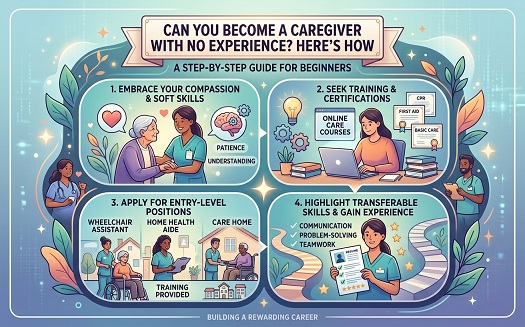
Yes — you can absolutely become a caregiver with no prior professional experience. Unlike many healthcare and social care roles that require years of prior training or a specific academic background, caregiving is one of the most genuinely accessible entry points into meaningful, paid work available today. Thousands of people successfully move into caregiving every year with no previous paid care experience at all, coming from retail, hospitality, administration, or simply from raising a family — and go on to build real, lasting careers in the field.
That doesn't mean showing up with nothing and hoping for the best. There's a clear, practical path that takes you from "no experience" to "job-ready caregiver," and it's shorter and more achievable than most people assume. This guide walks through exactly how that path works, what employers are genuinely looking for from newcomers, and how to close the experience gap efficiently — starting with an accredited online caregiver certification course.
Why Caregiving Is Genuinely Accessible to Newcomers
Before getting into the practical steps, it's worth understanding why caregiving specifically welcomes people without prior experience, in a way many other fields don't.
It's part of the non-regulated care workforce. Unlike nursing, medicine, or social work, caregiving doesn't require a licence, a degree, or years of prior study before you're legally permitted to start. This structural reality is exactly why a well-designed online caregiver certification course can meaningfully prepare you for entry-level work in a matter of weeks.
Demand consistently outpaces supply. The care sector across the UK and internationally faces persistent staffing shortages driven by an ageing population and growing demand for home-based care. This structural demand means employers are often genuinely motivated to bring in and train new candidates, rather than exclusively competing for a small pool of already-experienced carers.
Much of the role draws on life skills you likely already have. Patience, clear communication, reliability, empathy, and the ability to stay calm under pressure aren't skills exclusive to people who've worked in healthcare before — they're skills built through parenting, customer service, teaching, retail, or simply navigating life's ordinary challenges.
Training is specifically designed for beginners. Reputable caregiving certification courses assume no prior background whatsoever, building from first principles — what caregiving actually involves, professional standards, communication, and core practical skills — rather than assuming any existing healthcare knowledge.
What Employers Actually Look For Instead of Experience
If experience isn't the deciding factor for entry-level caregiving roles, it's worth understanding what genuinely does matter to hiring managers evaluating candidates with no prior professional background.
A recognised training certificate. This is, by a wide margin, the single most important substitute for direct experience. A Beginner Certificate or Diploma in Caregiving demonstrates that you understand the fundamentals — professional standards, safeguarding, communication, and essential caregiving skills — even without having practised them in a paid role yet.
Genuine motivation and reliability. Employers in this sector deal with real staffing pressure and value candidates who demonstrate they're serious about the work and likely to stay, rather than simply treating a caregiving role as a stopgap.
Evidence of relevant transferable experience, even informal. Time spent caring for a family member, volunteering, working in customer-facing roles, or any experience demonstrating patience and responsibility for others' wellbeing all count meaningfully, even without a formal job title attached.
Clean background checks and eligibility to work. As with any care role, you'll need to be eligible for an Enhanced DBS check and able to provide proof of your right to work — administrative requirements rather than experience barriers, but genuinely important nonetheless.
A willingness to learn on the job. Many employers explicitly plan for some on-the-job training and supervision for new starters, meaning they're not expecting you to arrive already fully proficient — they're looking for a foundation to build on, which is exactly what certification provides.
The Transferable Skills You Might Not Realise You Already Have
One of the biggest psychological barriers for people considering caregiving with no professional background is underestimating the skills they already possess. Here's a closer look at some of the most valuable ones, and where they commonly come from:
Patience under repetitive or difficult circumstances — built through parenting young children, managing customer complaints in retail or hospitality, or simply navigating long, demanding workdays in any customer-facing role.
Clear, adaptable communication — developed through teaching, sales, customer service, or any role requiring you to adjust how you explain things depending on who you're speaking with.
Physical stamina and comfort with hands-on work — built through retail, hospitality, warehouse work, cleaning, or any physically active job requiring you to be on your feet for extended periods.
Emotional resilience during stressful situations — developed through any high-pressure customer-facing role, healthcare-adjacent work, or navigating your own family's difficult life events.
Organisational skills and attention to detail — built through administrative work, event planning, running a household, or managing multiple competing responsibilities simultaneously.
Genuine compassion and a desire to help others — this one isn't built through any specific job; it's either something you already carry into this decision, or it develops naturally once you begin the work, but it's worth recognising in yourself if you're drawn to caregiving in the first place.
Recognising these existing strengths isn't just a confidence exercise — it's directly useful when you come to write your CV and prepare for interviews, since translating them into caregiving-relevant language is exactly how you demonstrate readiness despite lacking a formal job title in the field.
Step-by-Step: How to Become a Caregiver With No Experience
Step 1: Choose and complete an accredited online caregiver certification course
This is, without question, the most important step in the entire process. A recognised Beginner Certificate or Diploma in Caregiving transforms you from an uncertified newcomer into a candidate with documented, verifiable competency in exactly the areas employers look for. For someone starting with genuinely no experience, this single step does more to open doors than almost anything else you could do.
Choose a beginner certificate if you want to enter the job market as quickly as possible, or a full diploma if you want a more comprehensive foundation — including dementia care, personal care protocols, and end-of-life support — from the outset. Either way, confirm the course is accredited by named, checkable bodies before enrolling, since this directly affects how seriously employers will treat your certificate.
Step 2: Consider gaining some informal exposure before or alongside your certification
While not strictly necessary, some hands-on exposure to caregiving environments can strengthen your confidence and your eventual applications. Volunteering is one of the most accessible ways to gain this exposure without needing prior qualifications. According to official UK government guidance on volunteering, volunteer opportunities are widely available through organisations like the National Council for Voluntary Organisations, NHS Volunteering, and various local and national volunteering platforms — many of which include roles supporting older people, people with disabilities, or those in hospital or care home settings.
Even a few weeks of volunteering alongside your certification gives you something concrete to discuss in interviews, and often provides a natural reference contact for your eventual job applications.
Step 3: Rewrite your CV to translate your existing life experience into caregiving-relevant language
This step is frequently underestimated by first-time applicants. Rather than presenting a CV that looks like a gap punctuated by unrelated jobs, actively translate your existing experience into the language hiring managers are looking for. If you managed a busy retail counter, frame it around your ability to stay calm and communicate clearly under pressure. If you raised children, frame it around your experience managing daily routines, personal care, and responding to changing needs — skills directly relevant to caregiving, even though the job title never said "carer."
Step 4: Prepare for the practical administrative requirements
Familiarise yourself with what's involved in an Enhanced DBS check, gather any documents needed to prove your right to work, and think ahead about who might provide a reference — even without prior paid care experience, a reference from a previous employer, a volunteering supervisor, or a community leader who can speak to your character and reliability carries real weight.
Step 5: Target employers and roles that explicitly welcome newcomers
Many home care agencies and residential care providers specifically advertise entry-level roles designed for candidates without prior experience, often citing "full training provided" or "no experience necessary" directly in their job postings. Focus your initial search on these roles specifically, rather than more specialised or senior positions that assume existing caregiving experience.
Step 6: Prepare to speak honestly and confidently about your motivation in interviews
Hiring managers routinely interview candidates without prior caregiving experience and are generally well-practised at evaluating genuine motivation and character rather than penalising an absence of formal work history. Be ready to explain clearly and specifically why you're drawn to caregiving, what your certification taught you, and how your existing life experience has prepared you for the role's demands.
Step 7: Accept that your first few months will include real on-the-job learning, and that's expected
No employer hiring an entry-level, newly certified candidate expects you to arrive fully proficient in every situation you'll encounter. Most provide induction training, supervision, and support during your early weeks — your certification provides the foundation, but real confidence builds through actual practice, which is a completely normal and expected part of starting any new caregiving role.
Common Career-Changer Profiles Who Successfully Enter Caregiving
It can be genuinely reassuring to see how varied the backgrounds of successful newcomer caregivers actually are. A few common, well-established profiles include:
The retail or hospitality worker seeking more meaningful work. Years spent managing demanding customers, staying composed during busy periods, and juggling multiple responsibilities at once translate directly into caregiving's core demands, and many people from this background describe finding far greater personal satisfaction in caregiving than in their previous roles.
The stay-at-home parent returning to paid work. Managing a household, caring for children through illness and daily routines, and coordinating multiple people's needs simultaneously builds an enormous, directly relevant skill set — often underestimated by the parents themselves until they see it reflected back in caregiving job descriptions.
The recent graduate exploring career options. Without a fixed idea of what career to pursue, some graduates discover caregiving offers genuine purpose, human connection, and a faster route to meaningful, paid work than many graduate schemes in unrelated fields.
The mid-life career changer seeking more purposeful work. People in their 40s and 50s frequently move into caregiving from entirely unrelated fields — finance, retail management, administration — often citing a desire for work that feels more directly connected to helping people, alongside appreciating the relatively fast, accessible route in compared to retraining in other fields.
The person returning to work after a career break. Whether the break was for health reasons, family responsibilities, or simply a change of direction, caregiving's accessible entry requirements make it a genuinely realistic option for re-entering paid work without needing to explain away a long employment gap in an unrelated field.
The person who has recently completed family caregiving responsibilities. As covered in other guides on this topic, many people transitioning out of an unpaid family caregiving role — whether due to a relative's recovery, transition into residential care, or bereavement — find that paid caregiving offers a natural, meaningful next step that builds directly on experience they already have.
Recognising yourself in one of these patterns, or in a combination of several, is a useful reminder that "no experience" is a starting point shared by a huge number of people who've gone on to build genuinely successful caregiving careers.
Building Your First Caregiving CV From Scratch
Since many newcomers struggle specifically with how to present themselves on paper, it's worth walking through this in more concrete detail.
Lead with your certification, not apologetically buried experience. Place your caregiving certificate or diploma prominently near the top of your CV, including the specific accrediting bodies behind it — this is your strongest, most directly relevant credential, and it should read that way.
Create a dedicated "relevant skills" section. Rather than relying solely on a chronological work history that may look unrelated to caregiving at first glance, include a section explicitly translating your transferable skills — communication, patience, physical stamina, reliability — into language that speaks directly to caregiving's demands.
Describe any informal caregiving experience specifically and seriously. If you've cared for a family member, volunteered, or supported a friend through illness, describe this with the same professional detail you'd give any paid role: duration, specific responsibilities, and particular challenges you navigated.
Address your motivation directly in a personal statement or cover letter. Briefly and genuinely explain why you're moving into caregiving now, connecting your certification, any relevant life experience, and your personal motivation into a coherent, honest narrative rather than leaving a hiring manager to guess.
Keep your formatting clean, clear, and easy to scan quickly. Hiring managers reviewing many applications for entry-level roles often skim CVs quickly — a clear, well-organised document that immediately surfaces your certification and relevant skills gives you a real advantage over a cluttered or unclear one.
Don't undersell unrelated work experience entirely. Even a job with no obvious connection to caregiving demonstrates reliability, the ability to hold down paid work, and general professionalism — brief, factual mentions of unrelated roles still add legitimate value to a CV that's otherwise built around your new caregiving credentials.
Choosing the Right Course Level When You're Starting From Zero
For someone with genuinely no prior background in caregiving, the choice between a beginner certificate and a full diploma comes down mainly to your timeline and how much you want to invest upfront.
A Beginner Certificate in Caregiving is specifically designed to take someone with zero background and prepare them for entry-level work as efficiently as possible. If your primary goal is starting to earn as quickly as possible, this is the right starting point — you can always build toward a diploma once you're established.
A full Diploma in Caregiving makes sense if you're not under immediate time pressure and want to enter the job market with a stronger, more comprehensive foundation from day one — particularly useful if you're specifically drawn to working with clients experiencing dementia, complex health conditions, or requiring end-of-life support, since these are exactly the areas a beginner certificate doesn't cover in depth.
Neither choice requires any prior experience or qualifications to enrol — both are built as standalone, complete introductions to caregiving, meaning you can start directly from the course catalogue regardless of your current background.
What Your First Few Months as a New Caregiver Actually Look Like
It helps to have a realistic picture of what happens after you're hired, since this is often where anxiety about "no experience" peaks even after successfully landing a role.
Your first days typically involve employer-specific induction. Most care providers walk new starters through their specific policies, procedures, and expectations, regardless of your certification level — this is standard practice, not a sign you're behind.
You'll likely work alongside more experienced colleagues initially. Shadowing an experienced carer for your first shifts is common practice, giving you a chance to observe real situations before managing them independently.
The employer-led Care Certificate process often begins around this time. In the UK specifically, many care providers formally work through the sector-standard Care Certificate induction with new staff during their first weeks, building on the foundation your independent certification already gave you.
Early mistakes and uncertainty are normal, not a sign you've chosen the wrong path. Every experienced caregiver was once a first-week newcomer navigating unfamiliar situations. What matters is your willingness to ask questions, seek guidance, and apply what your certification taught you — not arriving with flawless instincts from day one.
Confidence builds steadily over the following weeks and months. Most new caregivers report feeling meaningfully more confident within their first month, as the combination of formal training and real hands-on practice starts to click into place.
Addressing the Common Fears That Hold Beginners Back
"I won't know what to do in an emergency." Reputable certification courses cover recognising and responding to common emergency situations, and employers typically provide additional emergency procedure training during induction. You won't be left entirely on your own to figure this out.
"I'm worried I'll say or do the wrong thing with a client who has dementia." This is precisely the kind of scenario a comprehensive Diploma in Caregiving specifically prepares you for, covering dementia-specific communication techniques designed to build confidence before you ever encounter these situations on the job.
"What if I'm not physically strong enough for the role?" Caregiving does involve physical activity, but most tasks are designed around proper technique rather than raw strength — courses cover safe manual handling and mobility support techniques specifically to protect both you and your client.
"I'm changing careers later in life — will I be taken seriously?" Career changers, including those in their 40s, 50s, and beyond, are common and often well-regarded in caregiving specifically, since life experience and maturity are genuine assets in this field rather than liabilities.
"What if I get overwhelmed emotionally by the work?" This is a genuine, reasonable concern, and it's worth acknowledging that caregiving does involve real emotional weight. Good employers provide support and supervision, and building your own coping strategies over time — something certification courses often touch on — is part of developing genuine professional resilience in this field.
Realistic Expectations: What Certification Can and Can't Do for You
It's worth being honest about the limits of certification alongside its genuine value, since setting realistic expectations helps you approach this transition with confidence rather than either overconfidence or unnecessary anxiety.
What certification genuinely does: it gives you a real, tested foundation of knowledge, makes you a credible candidate to employers despite lacking paid experience, and meaningfully shortens the learning curve you'll face once you start working.
What certification doesn't do on its own: it doesn't replace the confidence and instinct that comes from real, hands-on practice over time, and it doesn't guarantee every situation you'll encounter feels immediately familiar. This is completely normal, and it's exactly why employer induction, supervision, and the Care Certificate process exist alongside your independent certification — together, they form the complete picture of how someone with no prior experience becomes a genuinely competent, confident caregiver.
Why Now Is a Genuinely Good Time to Start
Beyond the personal readiness factors covered throughout this guide, there are structural reasons why entering caregiving with no prior experience is a particularly sound decision right now.
Sustained sector demand shows no sign of slowing. An ageing population across the UK and comparable countries means demand for trained caregivers continues to outpace available supply, giving newly certified candidates genuine leverage in the job market rather than facing intense competition for scarce roles.
Online certification has matured significantly. The route from "no experience" to "job-ready" has become considerably faster and more accessible than it was even a decade ago, thanks to well-structured, properly accredited online courses that didn't widely exist in their current form previously.
Flexible, self-paced study fits modern working lives. Whether you're currently employed elsewhere, managing family responsibilities, or navigating a career transition, the ability to study around your existing schedule — rather than committing to a fixed-term college course — removes one of the biggest historical barriers to retraining later in life.
Employers are increasingly used to hiring newly certified candidates. As certification has become a more standard, recognised part of entering the profession, hiring managers have grown more comfortable evaluating candidates on the strength of their training and motivation rather than requiring extensive prior experience.
Taken together, these factors mean that starting your caregiving journey now, with no prior experience, isn't a compromise or a slower route into the field — it's a genuinely well-supported, well-timed path that a large and growing number of people are successfully taking.
Frequently Asked Questions
Can I really get hired as a caregiver with absolutely no prior experience? Yes. Caregiving is one of the more genuinely accessible professions for career changers and newcomers, particularly when paired with a recognised online caregiver certification course that demonstrates your readiness despite lacking formal work history in the field.
Do I need any qualifications before I can enrol in a caregiving certification course? No. Reputable beginner certificates and diplomas in caregiving are specifically designed for complete beginners and require no prior qualifications or experience to enrol.
Will volunteering really help if I don't have paid experience? Yes, even a modest amount of volunteering — through organisations found via resources like gov.uk's volunteering guidance — gives you concrete experience to discuss in interviews and can provide a valuable reference contact.
How do I explain having no prior caregiving experience in a job interview? Be direct and honest, while emphasising your certification, any relevant transferable skills from previous roles, and your genuine motivation for entering the field. Hiring managers routinely interview and hire candidates without prior caregiving experience.
Should I start with the beginner certificate or the full diploma if I have zero background? If you want to start working as quickly as possible, begin with the Beginner Certificate in Caregiving. If you're not under immediate time pressure and want a more comprehensive foundation from the outset, the full diploma is a reasonable starting point even for complete beginners, since it requires no prior experience either.
Is it normal to feel nervous about starting caregiving work with no prior experience? Completely normal, and shared by nearly everyone who has ever entered this field for the first time. Certification, employer induction, and initial supervision are specifically designed to support you through this transition.
How long until I feel genuinely confident as a new caregiver? Most new caregivers report a meaningful increase in confidence within their first month of paid work, as formal training and real hands-on practice begin reinforcing each other.
Final Thoughts: Your Starting Point Is More Common Than You Think
If you're considering a caregiving career with no prior professional experience, you're not facing an unusual obstacle — you're following one of the most common, well-supported paths into this profession. Caregiving was built to be accessible precisely because the sector needs committed, trainable people far more than it needs a narrow pool of already-experienced candidates. The real starting point isn't experience — it's a recognised certification that turns your genuine motivation and existing life skills into something an employer can act on.
If you're ready to take that first step, you can create a free account and explore the Certificate and Diploma in Caregiving courses here — both built specifically for learners starting with no prior background, covering everything you need to move confidently from zero experience to job-ready.
Your caregiving career can genuinely start today, wherever you're starting from. Visit MS Caregivers Academy to begin your Continued Professional Development journey.